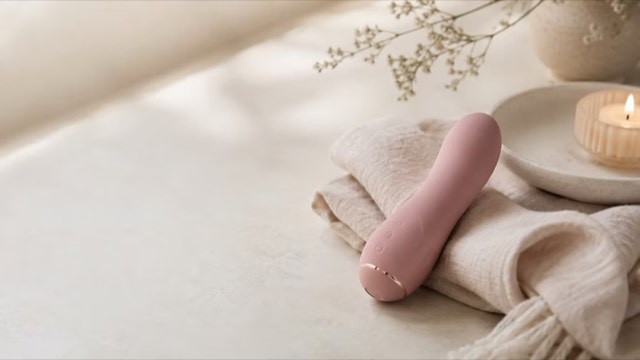
A thoughtful guide to introducing toys with a partner
You want to suggest a toy without making your partner hear 'you're not enough.' Here's how I'd start the conversation, shop together and leave room for a real no.

Abigail Reyes
December 7, 2025 · 5 min read

Abigail's quick take
“I would have the first conversation away from sex, make the invitation specific and leave room for a genuine no.”
- Best for
- Partners who are curious about shopping or using a pleasure product together.
- Keep in mind
- A surprise purchase can feel like a decision made for somebody else's body.
Have the first conversation somewhere unsexy
The sofa, a walk or a lazy Sunday coffee is better than the middle of sex. In bed, a suggestion can sound like an urgent performance review even when you meant it as curiosity. Outside the moment, both of you have room to ask questions and think before answering.
I would start small: 'I read about this and wondered whether it might be fun for us. No pressure—would you be open to looking together?' That sentence says what you want, makes the invitation shared and leaves a visible exit.
Avoid unveiling a purchased toy as a surprise unless your partner has already said surprises like that are welcome. A gift can feel like a decision that has been made for their body. Browsing together is less theatrical and usually much more intimate.
Say what you are excited about, not what they are failing to do
'I think it could be exciting to try a different sensation together' lands very differently from 'I need more than this.' Even if you do want something to change, begin with the experience you hope to build rather than a list of shortcomings.
Toys do not replace a partner, but insecurity is not irrational. Hands do not vibrate indefinitely and bodies cannot always sustain the same movement; a tool can add sensation or reduce effort. Say that plainly. Reassurance is more convincing when it addresses the actual fear instead of laughing it away.
If orgasm has become the unspoken scorecard, be especially careful. A toy should not arrive as equipment to fix someone. Frame the first try as exploration with no required result, and agree that either person can stop or change direction without apologising.
Shop for both bodies, even if the toy touches only one
Ask about sensation, noise, size, control and boundaries before you fall in love with a product photograph. Does either person dislike strong vibration? Is app control exciting or invasive? Does penetration belong in this experiment at all? A couples' label on the box cannot answer those questions.
Some of the best shared toys are ordinary wands, bullets or massage products that either person can hold. Wearables designed for intercourse can be clever, but fit is highly individual and they take up physical space. I never promise that a C-shaped toy will comfortably stay put for every couple.
Decide who controls it, then make that control reversible. A remote can feel playful when the receiving partner knows they can pause instantly. Agree on a word or gesture for lower, stop and 'not that pattern' before the app is connected.
Make the first try deliberately low stakes
Charge and wash the toy in advance, learn the controls together while clothed and keep compatible lubricant nearby. Nothing dissolves the mood faster than two adults squinting at a single flashing button while a magnetic charger falls off for the fourth time.
Try the toy during touch you already enjoy rather than making it the entire event. Start on the lowest setting. The person receiving the sensation can guide the hand holding it, which is often easier than explaining pressure and angle from scratch.
Check in with specific questions: 'Softer or stronger?' 'Keep it there or move?' 'Do you want control?' A nervous 'Is this okay?' can produce an automatic yes; choices make it easier to give an honest answer.
If the answer is no—or not yet
A no is not the opening position in a negotiation. Thank your partner for being honest and do not spend the evening presenting evidence. Pressure teaches someone that future honesty will create work, which makes the next conversation harder rather than easier.
You can ask at another time whether the boundary is about this product, the timing, privacy, cost, a past experience or toys in general—but only if they are willing to talk. Sometimes 'not with me' and 'not ever' are the real answers. Compatibility questions deserve honesty, not coercion.
Solo use within a relationship is another conversation worth having. Partners can have privacy and independent pleasure while still agreeing on boundaries that respect the relationship. There is no universal rule; there is only the agreement you make together.
The best outcome is not that a toy enters the bedroom. It is that both people learn they can talk about desire without being mocked, managed or punished for the answer. Everything enjoyable grows more easily from there.
This article is educational and is not a substitute for individualised care from a qualified professional.
Sources
- Consent, boundaries and ongoing communication — RAINN
- Defining sexual health — World Health Organization
Abigail's shortlist
What I'd genuinely point you toward
These aren't here to fill a product rail. Each one illustrates something I've talked about in this guide, and I've included the reason I'd consider it.
- couples
- communication