Rechargeable Sex Toy Care: Charging, Storage, and When to Retire It
That tiny magnetic charger looks harmless until it joins four nearly identical cables in a drawer. Here is how I would keep the right cable with the right toy, spot reasons to stop charging and retire the whole thing without turning battery care into an engineering course.

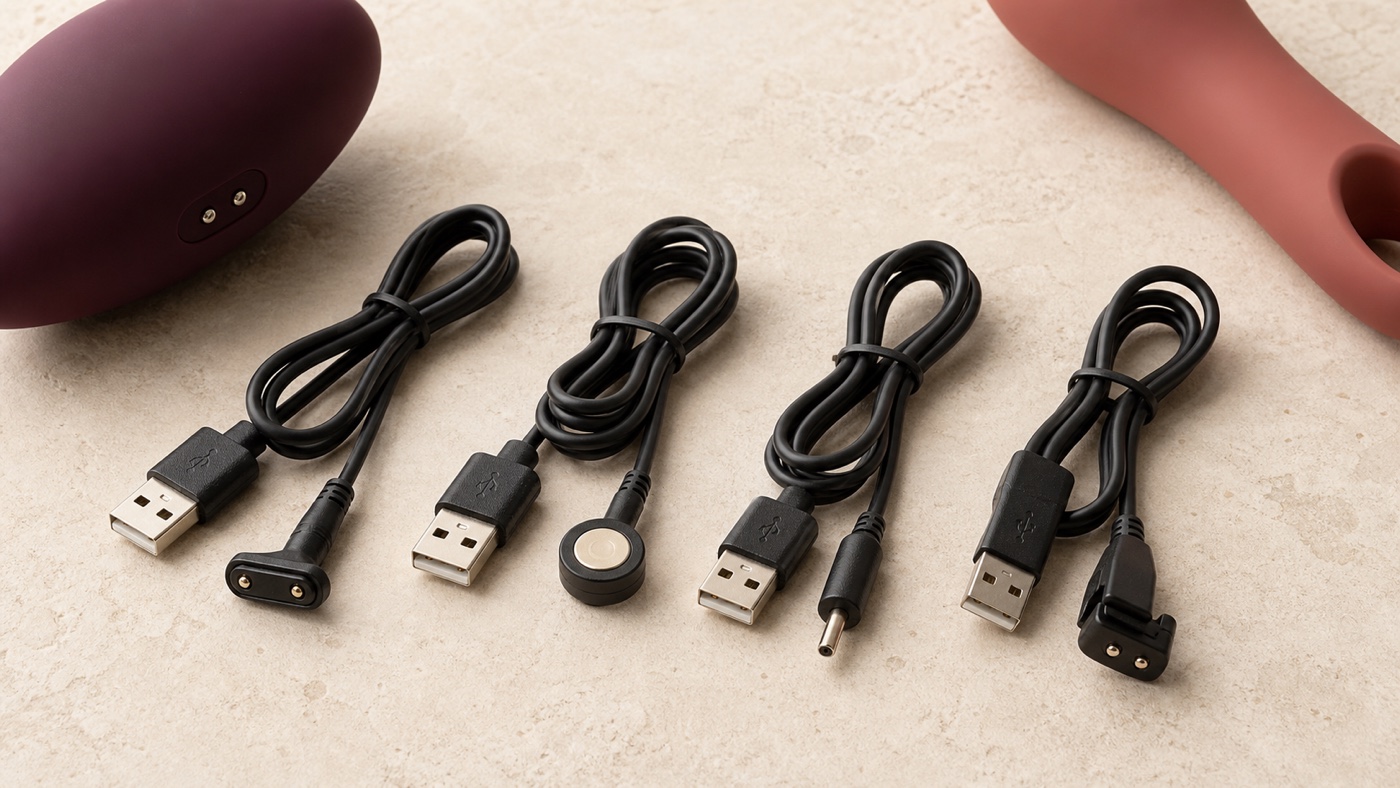
The correct charger is not simply the one that clicks
Rechargeable toys vary in ways that are difficult to see. Two magnetic connectors can look like twins while belonging to different products, and a familiar USB shape does not tell you what power source the toy expects.
The U.S. Consumer Product Safety Commission looks at the battery, the powered product and the charger as a system. That is the useful idea here: do not separate the cable from the thing it was chosen to charge.
My rule would be to start with the manual, original packaging or the manufacturer’s official support page. If the supplied cable is missing or damaged, ask the manufacturer what replaces it for that exact model. The mystery-cable drawer is many things, but it is not a technical specification.
I would also label the cable before it becomes a mystery. The toy’s name on a small tag is enough. This is an organization tip rather than a guarantee of safety, but it removes a very ordinary opportunity to guess badly.
Give everything a thirty-second look first
Before charging, look over the toy, its charging point, the cable and the adapter. You are not trying to diagnose the battery. You are checking whether anything has changed enough to make “plug it in and see” a poor next step.
For a device confirmed to contain a lithium-ion battery, the U.S. Fire Administration lists unusual odor, a change in color or shape, too much heat, leaking and odd noises as reasons to stop using it. I would treat any of those as a firm pause: move away from experiments and follow the manufacturer’s safety or disposal guidance.
That list is specific to lithium-ion batteries. If you do not know what battery is inside the toy, do not guess. Use the warnings in its manual or ask the manufacturer.
Waterproof language deserves the same literal approach. A toy that can go into the bath during use is not automatically ready to meet its charger while damp. Follow the charging instructions and let the product dry as directed. Our guide to cleaning and storing intimate products covers the washing side in more detail.
Charging should be the boring part
Use the cable, charger or power source named for the model. Follow the order in the instructions and let the toy’s documented light, display or app indicator tell you what is happening.
There is no useful universal charge time. One toy’s two-hour routine says nothing dependable about the next toy, and advice about leaving a device connected overnight also belongs to the exact manual. I would rather look up one page than turn somebody else’s rule of thumb into a battery experiment.
Pay attention if the device behaves differently from the instructions or from its usual charging routine. Unexpected heat, a shape change, leaking, an unusual smell or an odd noise is not an invitation to try another wall adapter. Stop using the device and get guidance from the manufacturer.
If there is smoke, fire or immediate danger, leave the area and contact local emergency services. The toy is replaceable; you are not.
Keep the cable out of the mystery drawer
Once the toy is clean and dry, store it as its maker recommends. I would keep the labelled cable and a copy of the manual in the same pouch or compartment, especially in a collection with several magnetic chargers.
Do not borrow a universal storage percentage from a phone, laptop or somebody’s battery-care thread. Long-term charge guidance can vary with the product and battery design. If the manual gives a storage routine, use it. If it does not, ask rather than invent one.
When a toy has been sitting unused for a while, give it the same quick look before charging again. Check the body, seams, charging point and cable. That is a calm precaution, not a forensic examination.
A tired battery is not a repair project
A shorter runtime is annoying, but it does not tell you exactly what has failed. I would not diagnose the battery from performance alone, and I would not promise that a charging trick can bring it back.
What matters is whether the device can still be used and charged according to its instructions without warning signs. If you cannot confirm that, stopping is the sensible choice.
Do not open a sealed toy, jump-start its battery, replace an internal cell or try an improvised charger. A rechargeable toy may contain a battery that was never designed for the user to remove. The U.S. Environmental Protection Agency makes the same point in its lithium-ion disposal guidance: not every battery is removable or serviceable by the person who owns the device.
Retiring a toy does not require solving the mystery first. Sometimes “I am no longer confident charging this” is enough information.
The rubbish bin is not the finish line
Start with the product label, manual or official support page. Look for the battery type, whether the battery is meant to be removed and any disposal directions. If the manual does not say, leave the device intact and ask the manufacturer or your local waste service.
In the United States, the EPA says devices confirmed to contain lithium-ion batteries should not go into household rubbish or curbside recycling. It directs people to separate battery or electronics recycling, a take-back service or a local household hazardous-waste program. If the battery is damaged, contact the manufacturer for handling instructions.
In the United Kingdom, the Office for Product Safety and Standards says batteries and electrical products marked with the crossed-out wheeled-bin symbol should go to an appropriate collection point rather than household rubbish. When the battery cannot be removed, the whole item is treated as electrical waste.
Elsewhere, check the official waste or recycling guidance where you live. Describe the item as a small rechargeable electrical device with a battery that may not be removable. That should get you a more useful answer than asking whether the council accepts “toys.”
If the product connects to an app or account, follow the manufacturer’s reset or account-removal steps before disposal—but only if the device is still safe to operate.
My calm battery-care checklist
Before charging:
1. Identify the exact toy. 2. Find its manual or official instructions. 3. Match the charging cable and power source to that model. 4. Look over the toy, charging point, cable and adapter. 5. Make sure the toy is dry and in the charging conditions its instructions require. 6. Stop if something looks, smells, sounds or feels unexpectedly different. 7. Use the manufacturer or your local waste service when it is time to retire the device.
None of this needs to feel dramatic. Good battery care is mostly about keeping the right information with the right object—and knowing when not to improvise.
Sources
- Batteries — U.S. Consumer Product Safety Commission
- Battery Fire Safety — U.S. Fire Administration
- Used Lithium-Ion Batteries — U.S. Environmental Protection Agency
- Consumer products—recycling batteries and electrical waste — UK Office for Product Safety and Standards
- How to clean and store intimate products — AboutSexToys
Codex reviewed the exact approved version against its recorded primary and authoritative source packet, preserving model-specific charging limits and localized disposal guidance.
- care
- charging
- rechargeable toys
- battery safety